SpectroDynamics 2026: Connecting computational spectroscopic methods across the electromagnetic spectrum
28 Sep 2026

Ciarán O’Brien is an Ada Lovelace Centre funded PhD student from the University of Liverpool. He is fully seconded into STFC Scientific Computing, where he is working on the project Simulation-assisted, electrochemical Vibrational Sum Frequency Generation at CLF-ULTRA in collaboration with the Central Laser Facility, developing simulation capabilities to support the interpretation of electrochemical VSFG experiments.
Recently, Ciarán was accepted to present this work at SpectroDynamics 2026, which brings researchers from across the spectroscopy community together for a five-day flagship school held at CECAM headquarters on the EPFL campus in Lausanne, Switzerland.
Ciarán O’Brien:
The CECAM Spectrodynamics workshop was devised to bring together theorists simulating observables from across the electrodynamic spectrum. From benchtop spectrometers and ultrafast laser facilities to kilometre-scale X-ray emitters – the light-matter interaction, the root of all observables, is essential to the work of scientists at facilities like Artemis, ULTRA, and Diamond. However, between different fields of chemistry and physics, models, physical approximations and even language used can vary significantly.
As an Ada Lovelace PhD student working intersectionally with laser spectroscopists and electrochemists at CLF-ULTRA and the University of Liverpool, my work on simulating electrode-electrolyte interfaces can help to identify catalytic mechanisms and suggest routes to energy-efficient recycling of CO2. This work can also provide interpretation for the spectroscopy that observes electrochemical interface, paired with our rapidly advancing capability to detect interface-specific reactions – building fundamental understanding of how electricity drives useful chemistry. However, building a useful model of the molecules is a different problem than building a useful model of the signal those molecules will emit when hit with light.

Delighted to see Ciarán has been making the most of what this joint studentship between ALC, University of Liverpool and CLF-ULTRA has offered him - well done Ciarán!
Gilberto Teobaldi, PhD Supervisor, Computational Materials and Molecular Science Theme Lead
This problem is a field of research unto itself; and I was very grateful to be offered a place at the spectrodynamics workshop to acquaint myself with the theoretical spectroscopy community properly. Organised by Yair Litman, Daniel Keefer (both of the Max Planck Institute for Polymer Research, Germany) and Franco Bonafé (IDEADED, S.L., Spain), the conference was attended by researchers at all career stages from UK, EU and international institutions. Notable invited speakers included Profs. Shaul Mukamel (U.C. Irvine), Peter Hamm (U. Zurich) Irene Burghardt (G.U. Frankfurt), Minhaeng Cho (Korea University), and Hardy Gross (Tsientang Institute for Advanced Study, China). These academics have written defining research about quantum dynamics that theorists and spectroscopists around the world draw on to design experiments, and event organisers facilitated interactive tutorials and Q&A sessions to allow attendees to get to grips with concepts formed from their collective decades of research.
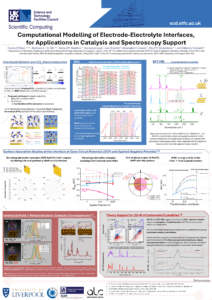
Of particular interest to my field of research were the lectures by Profs Marie Pierre Gaigeot (U. Paris-Saclay) and Thomas Markland (Stanford) discussing how they tackle the problems involved in modelling the response functions of liquids. Prof Gaigeot’s work on tractable sum frequency generation (SFG) spectroscopy of water, was developed over many collaborative studies with experimentalists – it allows the scientist to see signal only from the molecules at the surfaces of the sample. It is a powerful technique for catalysis chemistry and electrochemistry, and a state-of-the-art SFG laser facility is one of the key beamlines due to come online at Rutherford Appleton Laboratory in the coming years as part of the recently installed Central Laser Facility HiLUX upgrade. I also enjoyed the poster session, where I presented aspects of my project that tied into simulating interface vibrations, creating the opportunity for fruitful technical discussions on methodology with researchers tackling similar problems. At the end of the conference, the spectroscopy of electrochemical interfaces was listed as one of eight open challenges for computational spectroscopists in need of further theory development.
To find out more, please get in touch here.
ALC@stfc.ac.uk
The Ada Lovelace Centre is part of STFC Scientific Computing and is funded by UKRI