Staff Profile: Margaret Duff
11 Nov 2026

Staff Profile: Margaret Duff, Acting Inverse Problems Group Leader
Tell us about your role?
“I am the acting inverse problems group leader in the Computational Mathematics theme within Scientific Computing at STFC.
Inverse problems is a field of mathematics that uses incomplete or noisy data to work out what caused it. We start with observations and work backwards to uncover the underlying object, process or system.”
Can you tell us more about inverse problems?
“Inverse problems has applications across a wide range of scientific and engineering disciplines. One example everyone will be familiar with is how your phone can take noisy images captured in low light and ‘denoise’ them to produce a clean image. Similarly, if your hand wobbles while taking a picture, your phone can ‘deblur’ the image and recover a sharper version. These are both common inverse problems.
The Inverse Problems Group at STFC helps bridge the gap between mathematical research and real-world applications. We work with university researchers, facility scientists and colleagues across STFC to identify high-value problems and translate advanced mathematical techniques into practical solutions. This includes delivering training, signposting expertise and developing robust, sustainable software based on modern inverse-problem methods.
Inverse problems underpin many of the measurements made at STFC’s national facilities, helping scientists extract meaningful information from complex experimental data.”
What did you do before working at ALC?
“As well as working with the Ada Lovelace Centre, I often work with the Collaborative Computational Project in Imaging (CCPi) and Synergistic Reconstruction in Biomedical Imaging (CCP SyneRBI). These communities bring together researchers in imaging and provide software support and expertise.
Before joining STFC, I completed a PhD at the University of Bath in inverse problems and generative models, investigating how AI and mathematical methods can be combined to reduce the radiation dose and acquisition time required for biomedical imaging.”
What do you wish you had known earlier in your career?
“That no question is too stupid. If you are thinking about it, someone else is probably thinking about it too. Leading with curiosity, rather than worrying about what people might think of your question, leads to much more effective collaboration.”
What advice would you give to researchers who want to work in Computational Maths?
“Take every opportunity to interact with users of mathematics: engineers using statistical algorithms for anomaly detection, imaging scientists applying AI methods to segment data, or physicists solving large linear systems.
Find out what they are doing and practice developing a common language that bridges disciplines. This could be through university projects, summer internships, open days or public engagement events.”
Tell us something you have learnt about a project you have worked on recently
“We have recently been talking with scientists about how different energy neutrons pass through materials in different ways and what this can tell us about the object being studied. By measuring the time it takes for neutrons to pass through a sample, scientists can identify the materials it contains and, in some cases, even detect stresses and strains within it.
I find the range of experiments possible at the national facilities amazing. There is always something new to learn.”
What is your proudest career moment?
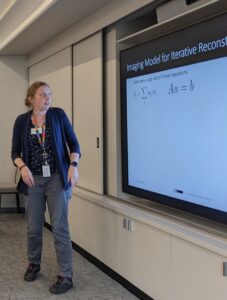
“I recently presented my work, and the work of members of my group, at the annual Bath-RAL meeting between the Mathematics Theme at STFC and the Numerical Analysis Group at the University of Bath. I completed my PhD at Bath, and many of the academics and students I worked with are still there. It was a proud moment to return and showcase the work of our group.”
What is the best thing about your role?
“I am always learning, not only from members of my group and theme, but also from the scientists I work with.
I particularly enjoy visiting instrument scientists on their beamlines, where the mathematical models we work on suddenly become tangible as you see the physical equipment and experiments in action. I also get to ask lots of questions, claiming ignorance as a mathematician rather than a physicist!”
What one thing would you like people to know about your work at ALC?
“People often have an image of mathematicians as lone individuals working with nothing but a pencil and a stack of paper. While we still sometimes do mathematics on paper, much of my work is about communicating with people, building collaborations and bridging the gap between the mathematics and applications communities.
In applied mathematics, much of the work is computational. We regularly run our own experiments, testing theories and validating mathematical derivations.”
What do you do when you are not at work?
“Outside work, I am a Cub Scout leader and Guide leader, and can often be found running around outdoors trying to count small children. There is a standing joke that although I have a PhD in mathematics, I cannot count past about six!”
What is the best thing about working for ALC?
“The variety is fantastic. One day I might be attending a mathematics conference and discussing a detailed mathematical proof; the next I could be delivering software training, and the day after that I could be back in the office talking with a scientist about a new project or idea.
The breadth of opportunities and interactions means that no two weeks are ever quite the same.”